Quick answer: Choose a basketball arcade machine by matching it to four things before you look at price: your venue type and floor plan, the number of players you need to serve per hour, the duty cycle your traffic demands, and the certifications your market requires. Then confirm the decision with a payback calculation. A machine that is too large for your aisle, or too light-duty for your traffic, costs more over five years than a correctly specified commercial unit.
Key takeaways
- Match the machine format to the venue before comparing prices. A bar, a mall game zone and a family entertainment center need different cabinets.
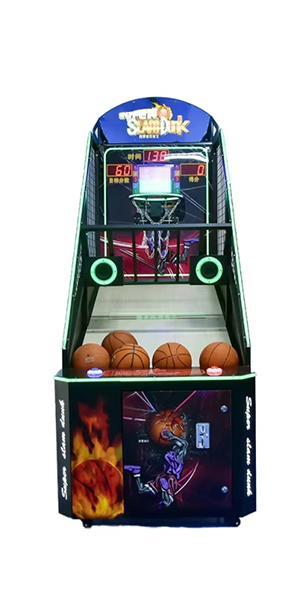
- A full-size commercial cabinet such as the National Basketball Arcade Machine measures 112 x 322 x 278 cm and weighs 150 kg, so verify floor loading for that point load, not just the free floor area.
- Duty cycle is the real dividing line between home and commercial equipment. Commercial units are engineered for 12 or more hours of daily use.
- If your plan includes four or more basketball units, specify native linking from the start. Retrofitting it later is expensive and sometimes impossible.
- Certifications are market-specific: CE plus RoHS for the European Union, UL plus FCC for the United States. Skipping them creates customs and liability problems.
- Model payback with your own traffic numbers before ordering. Payback Period = Total Capex / Average Monthly Net Profit.
Why the machine you choose matters more than the price you pay
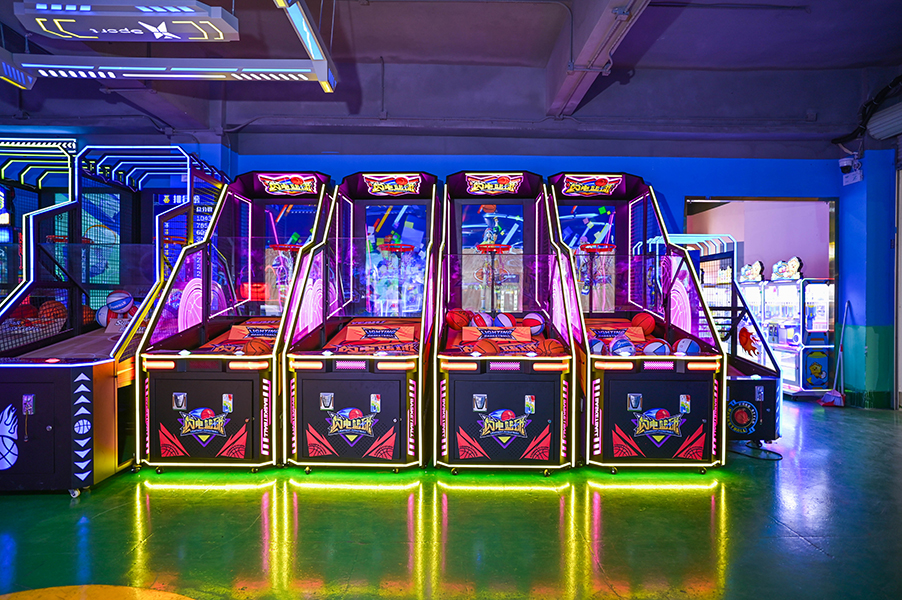
Most buyers start with budget. That is the wrong order. Two basketball arcade machines can look identical in a catalog photograph and still have completely different lifespans, sensor reliability and revenue performance. The difference shows up in month six, when one unit is still running 12 hours a day and the other is waiting on a replacement part.
For a full breakdown of price bands across arcade categories, see our commercial arcade machine pricing guide. This article takes the next step: how to specify the right basketball unit for your specific venue, and how to prove the decision with numbers.
How do you match a basketball arcade machine to your venue type?
Start with where the machine will physically stand and who will play it. The format follows from those two facts.
For venues that need the attraction without the full footprint, the Street Basketball Machine is a foldable option, and the base-free version suits locations that build the cabinet into an existing structure.
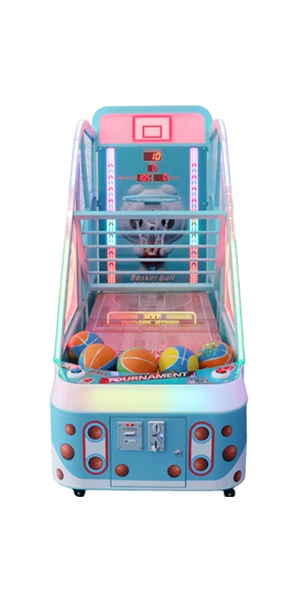
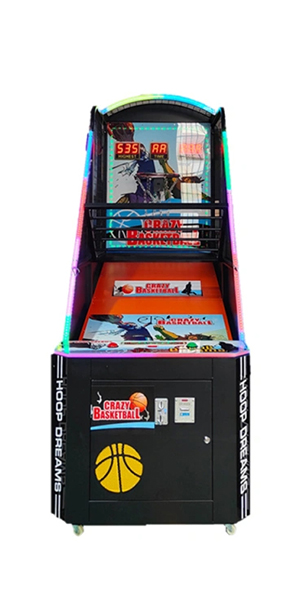
Two audience-matched cabinets worth comparing directly are the Commercial Adult Shooting Basketball Arcade Machine for adult and teen traffic, and the Kids Commercial Arcade Basketball Shooting Machine for family and soft play zones.
How much space does a commercial basketball arcade machine actually need?
Catalog pages list cabinet dimensions. They rarely tell you the space the machine truly occupies once a player is standing in front of it.
Using the National Basketball Arcade Machine as a real reference point, here are the verified specifications:
Three clearance rules to apply on top of the cabinet size:
- Player stance depth. Leave at least 1.5 m of clear floor in front of the cabinet. Players step back, lean and rotate; a tight aisle turns a good game into an awkward one.
- Service access. Keep 60-80 cm clear on the door side. All routine maintenance, including ball-return clearing and coin box collection, happens from that side.
- Ceiling and sightlines. Confirm the unit clears ceiling fixtures and does not block the sightline to higher-revenue machines behind it.
Finally, confirm floor loading. At 150 kg concentrated on a cabinet base, a raised or mezzanine floor needs verification before installation, not after.
Which gameplay features drive repeat play and revenue?
Durability keeps a machine alive. Gameplay design determines whether players come back. Four features matter most:
Progressive difficulty.
A machine with four levels keeps a first-time player engaged while giving a regular something to chase. Flat-difficulty machines get abandoned after two rounds. The LCD Display Basketball Arcade Game adds on-screen feedback that makes progress legible to the player.
Multiplayer competition.
Two players competing spend more, stay longer and attract onlookers. Multiplayer is the single highest-leverage feature for a machine placed in a high-visibility position.
Ball-return cycle time.
This is the most underrated specification in the category. If the return mechanism is slow, players wait between rounds, and the number of games per hour drops. A sluggish return reduces throughput directly, which is a revenue problem, not a convenience problem. Test the return cycle on a demonstration unit or ask for a video before you commit.
Reward integration.
Ticket payouts tied to score thresholds convert a single play into a repeat visit. If your venue already runs a card-based ecosystem, confirm the machine can integrate rather than stand alone. See our Card System options and Arcade Redemption Tickets range.
How do you judge duty cycle and build quality?
Duty cycle is the proportion of time a machine is designed to run under load. This is the single clearest difference between a home unit and a commercial unit. Commercial equipment is built for 12 or more hours of continuous daily operation; home equipment is built for occasional use.
Ask about these specific components, because they are what fails first:
- Score sensors. Optical and infrared sensors take thousands of impacts. Ask how the sensor is mounted and whether it is field-replaceable without dismantling the cabinet.
- Ball-return motor and drive. The highest-wear mechanical assembly in the machine.
- Coin acceptor and validator. The most-used component by count of interactions.
- Power supply and control board. Industrial-grade boards matter more than any cosmetic feature.
One practical rule from our own project experience: budget a wear-and-tear spare parts pack equal to roughly 5% of the order value at the time of purchase. Buttons, sensors, power supplies and critical mechanical parts. Downtime is the most expensive thing that can happen to a revenue-generating attraction, and a parts pack converts a two-week production-and-shipping wait into a same-day repair.
Which certifications does your market require?
Certification is non-negotiable, and it is market-specific. Confirm this before you place a deposit, not at the port.
AMA ARCADE machines hold CE, RoHS, SGS, UL and FCC certification. Documentation is available on our certificates page, and it is worth requesting the specific certificates for your model and destination market as part of the quotation.
Should you specify native linking from the start?
If your plan includes four or more basketball units, yes. Buy a system with native linking capability at the outset.
Retrofitting linking between existing machines is expensive, and if your units come from different brands it is sometimes simply impossible. Linked machines enable head-to-head tournaments, shared leaderboards and multi-unit events. Those formats raise average spend per player and give you a reason to run scheduled programming, which is what turns a bank of machines into an attraction.
The NBA Sports Arena Shooting Basketball Machine is designed for this kind of competitive multi-unit setup.
How do you calculate payback before you buy?
Use the same formula we apply to client projects:
Payback Period = Total Capex / Average Monthly Net Profit
Build the estimate in five steps:
- Daily plays. Estimate how many paid rounds the machine completes per day at your site. This is a function of round length, ball-return speed and your peak traffic hours. Track a comparable game already on your floor if you have one.
- Price per play. Your local market price, set in local currency.
- Gross daily revenue. Daily plays multiplied by price per play.
- Net monthly profit. Gross monthly revenue, minus your venue revenue share, minus maintenance and consumables.
- Divide. Machine cost divided by net monthly profit gives the payback period in months.
A worked example, with stated assumptions
Suppose the machine completes 60 plays per day at USD 1.00 per play, and your venue operates 30 days per month.
These figures are an illustrative model, not a projection. Every number above depends on your foot traffic, your local pricing and your venue agreement. Change the assumptions to match your site before you use the result. Sports and redemption machines in our published pricing band run from USD 800 to USD 4,500, which is the input you should replace the machine cost with.
How do you build a mix around the basketball machine?
A basketball machine performs better as part of a cluster than alone. Place it beside other competitive, fast-turnover sports games so players move between attractions instead of leaving.
Complementary categories to plan around:
- Arcade Sport Games for a broader sports floor
- Boxing Arcade Machine for an adult, competitive audience
- Air Hockey Table for two-player head-to-head play
- Electronic Dart Machine for bar and lounge settings
If you are planning a full venue rather than a single unit, our one-stop solution service covers the quote list, 2D and 3D layout design and site decoration planning, so the basketball machine is positioned as part of a traffic flow rather than dropped into leftover space.
Pre-purchase checklist
Print this and work through it before you place an order.
- Venue type and target demographic confirmed
- Cabinet format selected to match that demographic
- Cabinet dimensions checked against the actual installation point
- Player stance depth of at least 1.5 m confirmed
- Service-side access of 60-80 cm confirmed
- Floor loading verified for a cabinet of this weight
- Duty cycle rating matched to your daily operating hours
- Ball-return cycle time tested or reviewed on video
- Multiplayer capability confirmed for your layout
- Native linking specified if you plan four or more units
- Certifications confirmed for your destination market
- Spare parts pack and warranty terms agreed in writing
Choosing a partner, not just a product
AMA ARCADE has manufactured arcade equipment for 17 years, operates a 6,000 square meter factory, produces more than 16,000 units a year and serves over 3,100 customers across more than 150 countries. Every machine carries a one-year warranty on core hardware components with lifetime technical support.
If you are specifying a basketball arcade machine for a venue, send us your floor plan and target audience. We will come back with a recommended configuration, a quote list and a layout design. You can download our catalogue, review our frequently asked questions, or contact our team to start.
For buyers focused specifically on comparing supplier catalogs for indoor installations, our companion article on navigating supplier catalogs for basketball arcade game indoor solutions covers that evaluation in detail.