
How to Choose an Electronic Dart Machine for Bars and FECs

An electronic dart machine buyer's guide: target type, cabinet specs, throw-line space, payment setup, payback math, supplier checks and FOB terms.
Nov 3rd,2025 489 Views
Catalog

Quick answer: An electronic dart machine is a coin- or card-operated soft-tip dartboard built into a freestanding cabinet that scores every throw automatically, runs multiple game modes and supports league or online play. Choose one by matching target type and cabinet footprint to your venue, confirming 110–240 V power and CE/RoHS documentation, and checking that targets, sensor boards and tip supplies ship with the order.

This guide covers the decision framework: venue fit, specifications that hold up under daily use, payment and software setup, revenue modelling, supplier vetting, and import compliance. If you already know your shortlist and want to compare specific commercial models side by side, use our commercial dart machine model comparison instead — this page is about how to make the decision correctly.

1. Match the Machine to the Venue Before the Spec Sheet

Buyers usually start with the machine. Operators who keep the machine for eight years start with the room.

Venue type Typical player pattern Configuration that fits What to avoid
Neighbourhood bar Small groups, 20–40 min sessions, high weekend peaks 1–2 cabinets, 501/Cricket focus, coin or bill acceptor, compact footprint Oversized cabinets that eat table revenue
Sports bar with leagues Recurring teams, fixed match nights 2–4 networked cabinets, tournament mode, online leaderboard, card or app payment Machines without league or handicap modes
Family entertainment centre (FEC) Walk-up play, mixed ages, ticket or card ecosystem 2–6 cabinets near anchor attractions, card reader integration, family-friendly cabinet graphics Isolated placement away from traffic flow
Distributor / reseller Resale to multiple venues Standardised SKU, spare-part kits, OEM cabinet and software localisation One-off custom builds that break spare-part consistency

Two constraints decide the layout more often than anything else:

  • Throw-line depth. Regulation-style soft-tip play needs roughly 2.44 m (8 ft) from the board face to the throw line, plus about 0.6 m behind the player. Plan 3.5–4 m of usable depth per lane.
  • Ceiling and service access. Most commercial cabinets stand about 2.0–2.25 m tall. Keep at least 2.6 m of ceiling height so a technician can open the cabinet and lift the target assembly without removing the machine.

Confirm the figures against your local league rules before you fix the floor plan — regional associations differ by a few centimetres, and that difference decides whether a league will book your venue.
 

2. Specifications That Decide Whether the Machine Survives Year Three

Target type: soft-tip or steel-tip

Soft-tip (electronic) Steel-tip (electronic scoring)
Scoring Hole sensors behind a perforated target face Sensor matrix or camera behind a bristle/sisal target
Dart supply Plastic tips, consumable, low cost Steel tips, reusable, damages target over time
Player safety Safer for mixed-age and alcohol-serving venues Requires stricter lane control
Best fit Bars, FECs, arcades, anywhere with walk-up play Dedicated dart halls, competitive leagues
Operating cost Ongoing tip consumption Higher target replacement cost

Most revenue-generating installations in bars and FECs are soft-tip. Steel-tip electronic scoring is a specialist product for venues with a committed competitive base.

Sensor stability and scoring accuracy

Scoring errors are the fastest way to lose regulars — players forgive a worn cabinet, never a miscount. Ask for the sensor type (optical matrix or micro-switch), the miss/registration tolerance, and how the target face is replaced. A target that can be swapped in under 15 minutes by on-site staff protects your weekend revenue; one that needs a technician visit does not.

Cabinet construction

Check three things: frame material (metal frame rather than particle board), impact resistance around the target surround, and display readability under bar lighting. Anti-glare treatment on the LED display matters more in a dim venue than the panel's resolution.

Power and compliance

  • Voltage: confirm 110 V or 220–240 V, 50/60 Hz for your market, and specify the plug type.
  • Certification: CE and RoHS for the EU and many other markets, FCC documentation for North America. Ask for the certificate scope, not just the logo — a certificate that covers the cabinet but not the payment module will still stop your customs clearance.
  • Documentation pack: test report, certificate of origin, packing list with net and gross weight, and a wiring diagram for your technician.

3. Payment and Software: Where the Operating Margin Actually Sits

Game modes and league features

A commercial cabinet should ship with at least the standard competitive set — 501, Cricket, Cut-Throat, team and doubles variants — plus a practice mode. Beyond that, two features drive repeat visits: handicap settings (so weaker players stay in the league) and a leaderboard that can be displayed in-venue or online.

Payment configuration

Option Best for Note
Coin acceptor Bars, quick-service venues Cheapest to run; requires coin logistics
Bill acceptor Higher price per play, FECs Needs note-stack servicing routine
Card reader / cashless (Nayax-style or venue card system) Multi-machine FECs, chain operators Enables dynamic pricing and remote reporting
QR / app payment Markets with high mobile payment adoption Needs stable network in the venue

Cashless modules are not a default configuration on every cabinet. They are specified per order, and the machine's power supply and network environment must be confirmed before production — a venue with no reliable Wi-Fi will not get the reporting value the module promises. If you plan to run darts inside a card or token ecosystem, plan the integration with your arcade card management system at the same time you specify the machine, not after delivery.

Remote management

Play counts, revenue per cabinet, error logs and price changes are the four reports that justify a networked machine. Ask for a live demonstration of the dashboard before you commit to a multi-unit order, and confirm whether reporting is included or subscription-based.
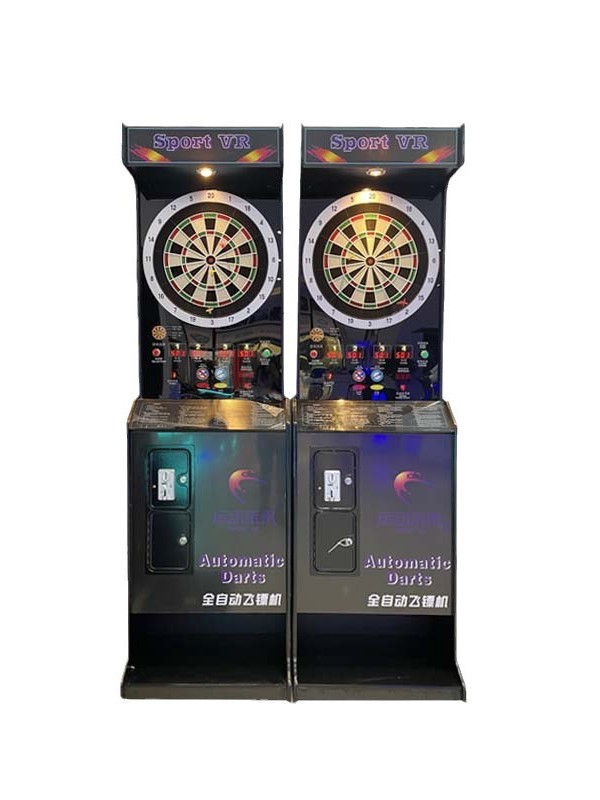
Metal-frame dart machine cabinet with impact-resistant target surround


4. Revenue Modelling: Build the Payback Yourself

Do not accept a supplier's payback figure. Run it on your own numbers with three inputs.

Monthly gross revenue = price per play × plays per day × open days per month

Payback (months) = all-in landed cost ÷ (monthly gross × (1 − venue share − maintenance reserve))

Price per play Plays/day Monthly gross (30 days) Annual gross
$1.00 30 $900 $10,800
$2.00 30 $1,800 $21,600
$2.00 50 $3,000 $36,000
$2.50 60 $4,500 $54,000
$3.00 60 $5,400 $64,800

Worked example using planning assumptions — replace them with your quotation and your floor data: all-in landed cost of $6,500 per cabinet (unit, freight, duty, installation), $2.00 per play, 45 plays per day, 30 open days, 25% venue revenue share, 8% maintenance reserve. Net monthly contribution is about $1,600, giving a payback of roughly four months. A low-traffic venue at 20 plays per day takes closer to nine.

Two levers move that number more than machine price:

  1. Placement. Machines near seating, screens and the bar route get walked past twenty times a shift. A quiet corner gets walked past twice.
  2. Scheduled competition. A weekly league night turns a $1,800/month cabinet into a $3,000/month cabinet without changing the equipment.

Calculate your own scenario before you shortlist hardware — it tells you what budget bracket is rational. For the wider revenue mix of a venue, see how operators combine sports arcade games, air hockey and basketball with darts to build a full floor.

5. Supplier Vetting: Eight Questions and the Answers That Should Worry You

Question Good answer Red flag
How long have you manufactured this specific product line? Named production line, dated export records "We can make anything"
Which certificates cover this exact model? Certificate number and scope you can verify Logo on a brochure, no document
What spare parts ship with a first order? Target assembly, sensor board, power supply, tip stock "Parts available on request"
What is the sensor replacement procedure? Written procedure, video, staff-level task "Send it back to us"
What is the warranty scope and period? Per-component terms in writing Blanket "one year" with no exclusions listed
Can you localise language and cabinet graphics? Confirmed artwork and firmware process "Yes" with no artwork specification
What are the packing dimensions and gross weight per unit? Stated per carton, wooden crate spec Only "standard export packing"
What are the payment and shipping terms? FOB/CIF options, deposit and balance split Full prepayment, no inspection

The last two matter more than buyers expect. Packing dimensions and gross weight determine your freight cost before you ever see the machine, and they are different from the machine's net dimensions — a common source of landed-cost surprises. If you are comparing suppliers for a larger equipment package, our one-stop FEC solution overview explains how mixed-container planning works.

6. Certifications, Voltage and Shipping: The Part That Delays Projects

Four issues account for most delayed installations:

  1. Voltage and plug mismatch. Ordering a 220 V machine for a 110 V site is recoverable; ordering the wrong plug type for a fixed installation is a rework job.
  2. Certificate scope. The certificate must cover the model and, where fitted, the payment module.
  3. Packing standard. Commercial cabinets ship in wooden crates with shockproof padding. Confirm crate dimensions and whether the crate is stackable for LCL consolidation.
  4. Lead time realism. Custom cabinet artwork and software localisation add production days beyond the standard lead time. Build them into the schedule, not on top of it.

Pricing is normally quoted FOB Guangzhou, which excludes ocean freight, insurance, duty and inland delivery. Ask for a CIF quote as well so you can compare landed cost rather than unit price.

7. Seven Mistakes That Cost Operators Money

Mistake What it costs Fix
Choosing cabinet design before scoring accuracy Lost regulars, warranty disputes Ask for the sensor spec and error tolerance first
Ignoring throw-line and ceiling clearance Illegal league setup or cramped play Measure the room before the shortlist
Skipping local voltage and payment checks Rework, delayed opening Confirm power and payment plan at order stage
Buying without a spare-parts kit 2–4 weeks of dead revenue per fault Add a consumables and boards kit to the first order
Assuming cashless is standard Retrofit cost and network surprises Specify cashless as a line item, confirm pre-production
Choosing the cheapest unit price Higher landed cost, weaker after-sales Compare landed cost and service terms
No league or event plan Machine runs at half its potential Schedule competition before installation

Choosing the Right Partner

The machine is a five-to-eight-year asset. What determines whether it earns through that period is the specification discipline at purchase and the spare-part and support structure behind it.

AMA ARCADE is the brand of Guangzhou AMA Amusement Equipment Co., Ltd., a manufacturer based in Panyu District, Guangzhou, with more than 17 years in amusement equipment. We build commercial dart cabinets with OEM and ODM options, supply venue operators and distributors internationally, and quote FOB Guangzhou with CE and RoHS documentation. Browse the electronic dart machine range to compare cabinet formats, or review after-sales support and spare parts before you specify a multi-unit order.

Ready to price a configuration? Send us your venue details — floor plan, voltage, payment method and target volume — and we will return a specification sheet and a quotation.

CONTACT US

Contact Our Sales Team for OEM/ODM Details
Name *
WhatsApp/Phone
Email *
Message *
Contact Us
Name *
WhatsApp/Phone
Email *
Message *
We use Cookie to improve your online experience. By continuing browsing this website, we assume you agree our use of Cookie.